Optimize Blue-Collar Profitability with Smart Leadership
Leadership, Blue-Collar Business, Profitability
Your Tech Isn't Worth $65K Yet (And That's Okay... For Now)
Before you hand out top-tier salaries or invest in shiny new tools, your business needs one thing first: a rock-solid handle on performance, accountability, and profitability. This is especially true in blue-collar industries, where every hour on the payroll directly affects your bottom line. At Deep Green Performance, we help owners see that it’s not about paying less, it’s about paying smart, with clear expectations and measurable results.
Business Performance Comes Before Big Pay checks
Let’s be blunt: a role isn’t “worth” $65K, $85K, or $100K just because someone wants it, or because another company is paying it. In blue-collar leadership, business performance has to set the ceiling for compensation, not emotion or comparison. If your crews, systems, and numbers can’t support that level of pay with healthy profit left over, you’re not underpaying, you’re overcommitting.
High-performing companies earn the right to pay high-performing wages. That starts with knowing, in black and white, what every department, crew, or technician produces in revenue, margin, and profit. Until those numbers are clear, “market rate” is just a guess and guesses are dangerous in a tight-margin, labor-heavy business.
Employee Accountability: Clarity Beats Complaints
Most owners don’t actually have an “employee problem.” They have a clarity problem. Employee accountability only works when people know exactly what winning looks like in their role. If your expectations live only in your head, your team will always feel like they’re guessing and you’ll always feel like they’re letting you down.
What does a productive day look like for a technician, operator, or crew lead?
How do they know if they’re on pace, behind, or ahead?
What happens consistently when standards are met, exceeded, or missed?
Accountability isn’t about being harsh; it’s about being specific. When you tie accountability to numbers and outcomes instead of moods and memories, your culture gets calmer, fairer, and more professional overnight.
Profitability Metrics: What You Don’t Measure Will Eat Your Margin
In blue-collar work, labor is usually your biggest expense. That means your profitability metrics must go deeper than “we made money this month.” You need to see how payroll, productivity, and pricing interact job by job, crew by crew. At Deep Green Performance, we encourage owners to track a few simple but powerful numbers:
Revenue per labor hour (how much each hour billed actually brings in)
Gross profit per crew or technician (after direct labor and materials)
Labor as a percentage of revenue (is payroll swelling while output stays flat?)
These metrics tell you, in real time, whether you can afford that next raise, hire, or piece of equipment or whether you’re quietly bleeding cash while everyone stays “busy.”

When leaders see labor, productivity, and margin together, better decisions follow quickly.
Blue-Collar Leadership: Systems, Not Superheroes
Blue-collar leadership is often built on grit and loyalty. Those are strengths but they’re not systems. To grow beyond survival mode, you need more than a few “go-to” people who save the day. You need repeatable ways of planning work, tracking time, measuring output, and coaching performance so that any competent person can succeed in the role.
The best leaders don’t just push harder; they make it easier for good people to do great work. That means documenting standards, simplifying workflows, and making the numbers visible to the people doing the work not hiding them in the office.
Payroll Management: Your Largest Lever on Profit
Payroll management is not just cutting checks; it’s designing how labor dollars move through your business. Every raise, bonus, and hire should be tied to a clear plan for increased revenue or efficiency. Otherwise, you’re adding weight without adding horsepower.
Set pay bands linked to role expectations and measurable outputs.
Review labor cost as a percentage of revenue every month, not once a year.
Connect bonuses to team or job profitability, not just “working hard.”
When payroll grows faster than performance, profit disappears. When payroll grows because performance and pricing improved, everyone wins and those higher salaries are truly earned and sustainable.
Productivity Standards: Defining What “Good” Looks Like
Productivity standards are your translation layer between payroll and profit. They answer the question: “For what we pay this role, what should we consistently get back in output?” Without standards, you can’t tell whether a $30/hour tech is a bargain or a burden.
Good standards are:
Specific - “Complete X units or bill Y hours per day,” not “do your best.”
Visible - Posted, tracked, and reviewed regularly, not hidden in a spreadsheet.
Linked to pay - Higher pay requires consistently meeting higher standards.
The 5X Rule: A Simple Filter for Smart Payroll Decisions
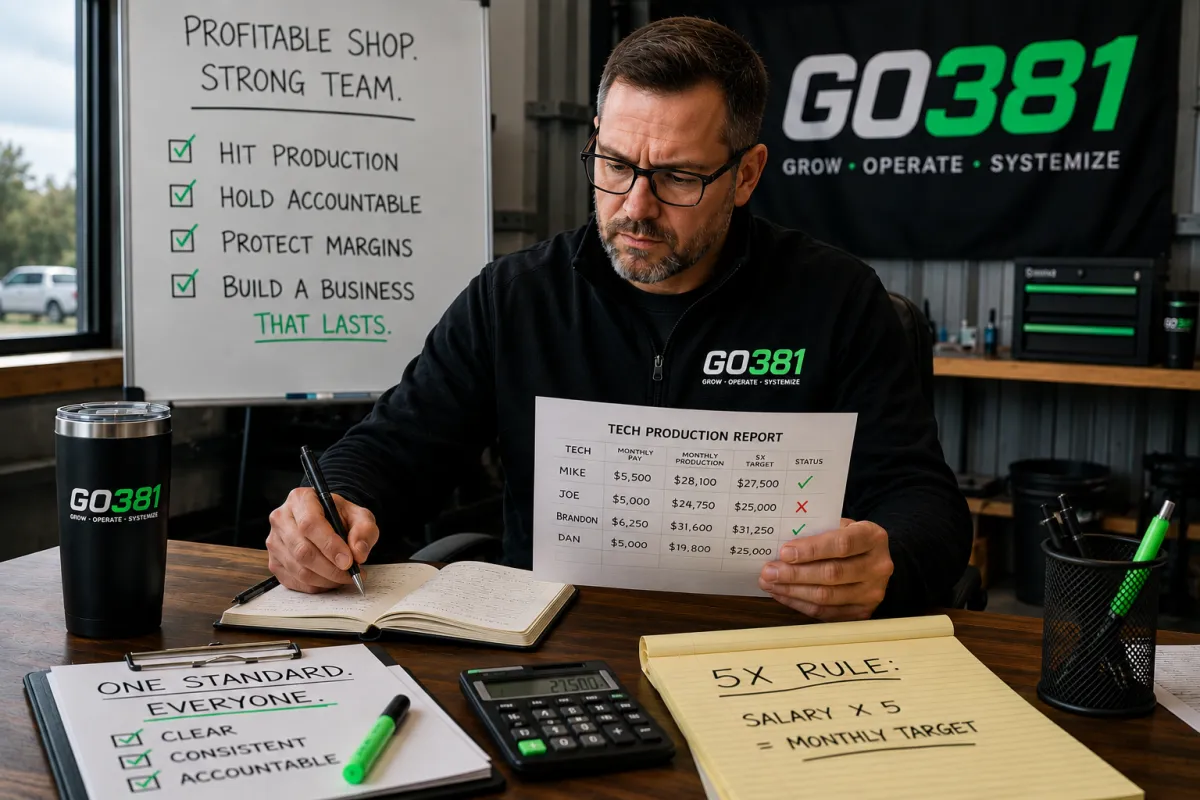
One practical way to sanity-check your labor costs is the 5X Rule. In plain terms: over time, a fully loaded role (wages, taxes, benefits) should generate at least five times its cost in revenue for the business to stay healthy, pay overhead, and still produce profit.
If a position costs you $65K a year, you should be designing that role, pricing, and workflow so that it can reasonably support $325K+ in revenue. That doesn’t happen by accident. It requires clear scopes of work, realistic schedules, and the courage to raise prices or refine your ideal customer when the math doesn’t work.
💡 Pro Tip: Before approving a raise, ask: “Can I clearly see how this role will produce at least 5X its total cost in the next 12 months?”
Performance Conversations: Where Accountability Becomes Culture
None of this works without regular, honest performance conversations. Posting numbers on a wall isn’t leadership. Sitting down with your people calmly, consistently, and with real data is where accountability turns into growth instead of resentment.
A simple monthly rhythm can change everything:
Review last month’s key metrics for the role or crew (hours, revenue, call backs, safety, profit).
Celebrate what went well specific wins tied to the numbers.
Identify one or two gaps and agree on clear actions for the next month.
Over time, your team learns that pay, promotions, and opportunity at your company are tied to performance, not politics. That’s how you keep good people, attract better ones, and justify those higher salaries with confidence.
Your Tech Can Be Worth $65K, When the System Is Ready
If your tech, foreman, or estimator isn’t “worth” $65K yet, it doesn’t mean they’re a bad person or you’re a bad leader. It means the system around them isn’t strong enough, yet. By tightening up business performance tracking, building real employee accountability, watching your profitability metrics, managing payroll with intention, setting clear productivity standards, applying the 5X Rule, and having regular performance conversations, you give your business and your people a fair shot at those higher numbers.
That’s the work of modern blue-collar leadership: not just working harder, but building a business where great pay is backed by great performance and durable profit. And that’s exactly the kind of foundation Deep Green Performance exists to help you build.
